
HIPAA Awareness For Mental Health Providers
Understanding Mental Health Providers HIPAA Awareness
As a mental health professional, you hold a sacred trust. Patients walk through your door, or log into your virtual waiting room, and share their most vulnerable thoughts, feelings, and experiences. This isn’t just “health information”; it’s deeply personal, often painful, and fundamental to their sense of self.
This is precisely why HIPAA awareness for mental health providers isn’t just a regulatory checkbox; it’s the framework that protects that trust, ensures your patients feel safe enough to heal, and ultimately, safeguards your practice. Understanding HIPAA isn’t just about avoiding fines; it’s about upholding the ethical core of what you do every single day.
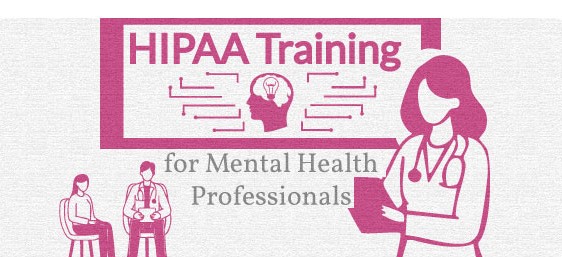
Audience:
Who Needs This HIPAA Awareness Course?
Examples:
This includes medical doctors specializing in mental health, such as Psychiatrists and advanced practice nurses like Psychiatric-Mental Health Nurse Practitioners. Therapy and counseling services are primarily offered by Psychologists, Licensed Professional Counselors (LPCs) or Licensed Mental Health Counselors (LMHCs), Licensed Clinical Social Workers (LCSWs), and Licensed Marriage and Family Therapists (LMFTs). Additionally, specialists like Substance Abuse Counselors focus on addiction treatment. Supporting these core providers in direct patient care are roles such as Mental Health Technicians or Psychiatric Aides, Case Managers who navigate resources, and Peer Specialists offering lived experience support.
Mental Health Providers HIPAA Course Overview
- Slides with Audio: Yes
- Self-Paced: Yes
- Avg Course Duration: 2 Hours / Course
- Format: Online Self-Paced Training
- Total Slides: 68
- Access: Online Access for 60 Days
- Certificate of Completion: Yes
- Certificate Expiry: 2 Years
- License: A single-user license cannot be transferred once a login is assigned.
Watch the Free Mental Health Providers HIPAA Training Demo in the Video:
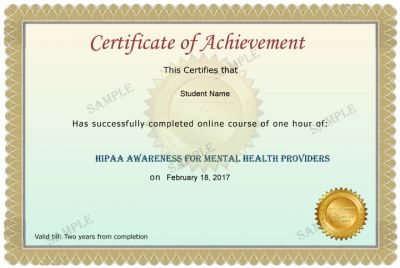
Mental Health Providers Sample Certificate
Certificate Expiry: 2 Years
See what our mental health providers’ HIPAA awareness certificate looks like.
Our Amazing Clients




How Mental Health Providers HIPAA Awareness Certification Test Works?
- When You’ll Be Tested: You’ll take a single test right after you’ve completed the entire Mental Health Providers HIPAA Awareness Training course.
- Passing Score: To earn your certification, you’ll need to achieve a score of 80% or higher on the 10-question exam.
- Retake Until You Pass: Don’t stress if you don’t pass on your first try! The exam can be repeated as many times as you need until you reach the passing mark.
- Quick and Convenient: The test typically takes just 10 minutes to complete.
- Instant Certification: Once you successfully pass the test, you can immediately print your Mental Health Providers HIPAA Awareness Training Certification.
- Format: All questions are in a multiple-choice format, making it straightforward to navigate.
Frequently Asked Questions
HIPAA stands for the Health Insurance Portability and Accountability Act. It’s a federal law that sets national standards for protecting sensitive patient health information (PHI). For mental health providers, it’s crucial because it builds and maintains patient trust, protects highly sensitive mental health data from unauthorized disclosure, and helps avoid significant legal penalties and reputational damage for non-compliance.
PHI is any individually identifiable health information, regardless of how it’s created, stored, or transmitted. For mental health providers, this includes everything from diagnoses, treatment plans, and therapy notes to appointment schedules, billing records, and even demographic details like names, addresses, and birth dates if they can be linked to a patient’s health.
Yes, “psychotherapy notes” (as specifically defined by HIPAA, which are typically process notes from individual or group therapy sessions kept separate from the main medical record) receive a higher level of protection than other types of PHI. Most disclosures of psychotherapy notes require specific patient authorization, even for treatment, payment, or healthcare operations, unlike other parts of the medical record.
You can generally share the “minimum necessary” PHI for treatment, payment, and healthcare operations (TPO) without specific authorization. However, for most other disclosures, including to family members, explicit patient authorization is required. In emergencies, or if a patient presents a serious and imminent danger to themselves or others, disclosure may be permitted without consent to prevent harm, but this is governed by strict rules and state laws. It’s always best to obtain consent when possible and document your rationale for any disclosure without consent.
The Security Rule requires you to protect the confidentiality, integrity, and availability of all electronic PHI. This means conducting regular risk assessments, implementing administrative safeguards (like policies and procedures), physical safeguards (like locked offices and secure devices), and technical safeguards (like encryption, access controls, and strong passwords).
You can, but it must be done through HIPAA-compliant, encrypted platforms with which you have a BAA. Standard, unencrypted email and text messaging are generally not HIPAA compliant for sharing PHI because they lack the necessary security safeguards. Always obtain patient consent for electronic communication and inform them of any risks.
Frequently Asked Questions
HIPAA stands for the Health Insurance Portability and Accountability Act. It’s a federal law that sets national standards for protecting sensitive patient health information (PHI). For mental health providers, it’s crucial because it builds and maintains patient trust, protects highly sensitive mental health data from unauthorized disclosure, and helps avoid significant legal penalties and reputational damage for non-compliance.
PHI is any individually identifiable health information, regardless of how it’s created, stored, or transmitted. For mental health providers, this includes everything from diagnoses, treatment plans, and therapy notes to appointment schedules, billing records, and even demographic details like names, addresses, and birth dates if they can be linked to a patient’s health.
Yes, “psychotherapy notes” (as specifically defined by HIPAA, which are typically process notes from individual or group therapy sessions kept separate from the main medical record) receive a higher level of protection than other types of PHI. Most disclosures of psychotherapy notes require specific patient authorization, even for treatment, payment, or healthcare operations, unlike other parts of the medical record.
You can generally share the “minimum necessary” PHI for treatment, payment, and healthcare operations (TPO) without specific authorization. However, for most other disclosures, including to family members, explicit patient authorization is required. In emergencies, or if a patient presents a serious and imminent danger to themselves or others, disclosure may be permitted without consent to prevent harm, but this is governed by strict rules and state laws. It’s always best to obtain consent when possible and document your rationale for any disclosure without consent.
The Security Rule requires you to protect the confidentiality, integrity, and availability of all electronic PHI. This means conducting regular risk assessments, implementing administrative safeguards (like policies and procedures), physical safeguards (like locked offices and secure devices), and technical safeguards (like encryption, access controls, and strong passwords).
You can, but it must be done through HIPAA-compliant, encrypted platforms with which you have a BAA. Standard, unencrypted email and text messaging are generally not HIPAA compliant for sharing PHI because they lack the necessary security safeguards. Always obtain patient consent for electronic communication and inform them of any risks.